![]() |
| Oseberg burial mound plates, VA prong forks, Novgorod spoons |
Friday, April 16, 2021
Moving and Kit/Garb Improvements
New Resources
2020/2021 have been quite a year with COVID times and trying to remodel/move into my new house! However, I wanted to share that I recently ordered two new books:
A Simplified Guide to Historic Tablet Weaving: https://books.google.com/books/about/A_Simplified_Guide_to_Historical_Tablet.html?id=HD5-zQEACAAJ
Tablet-Woven Treasures - Archaeological Bands from the Finnish Iron Age: https://www.salakirjat.com/product/351/tablet-woven-treasures---archaeological-bands-from-the-finnish-iron-age?fbclid=IwAR0-_KtkhwohtPQIpPamA5X6z2ySv7BKn-XwAqwjRAxFbvXlm2vJ4g5t5-c
The Tablet-Woven Treasures book is especially exciting to me because it is from the same authors that wrote Applesies and Foxnoses - which, in my opinion, is one of the most helpful books for learning tablet-weaving technique! It helped me improve my weaving so much and it is still a resource I look to - I can't wait to see what new research these ladies have uncovered!!
I also really have enjoyed looking through A Simplified Guide to Historic Tablet (B Sæmundarson, D Sveinsdóttir). It is really nice to have the historical information/discussion along with patterns so you can understand the author's process. I am weaving a missed-hole band from the book currently:
![]() |
| Page describing historical information regarding the Vestrum band |
![]() |
| Vestrum band woven from the pattern provided in A Simplified Guide to Historic Tablet |
I love the look of the Vestrum band and hope to use it to embellish my hand-dyed wool dress in the future!
Thursday, April 16, 2020
An Tir Kingdom A&S 2020
On March 7, 2020 I had the good fortune of presenting my latest brocade project at An Tir's Kingdom A&S event as a single entry (also my last in-person SCA event prior to COVID times):
Examination and execution of the brocaded tablet woven pattern from the painting “Bildnis einer Frau” – Portrait of a Woman by the Master of the legend of St. Ursula, circa 16th century.
I've included my paper's introduction, as it is a good initial summary of the project (please reach out to me if you are interested in the full paper):
In fifth century C.E. tablet weaving methodology shifted from woven patterns created from different colored threads to the addition of supplemental brocade wefts woven into plain, often single-colored, tablet woven bands.1 Brocade tablet woven bands are some of the most visually impressive tablet woven examples due to the rich surface effect achieved that is similar to embroidery and often utilizes precious metals to create the surface pattern. Brocade tablet woven bands were widely produced and are present in archeological evidence throughout Europe, enjoying popularity from sixth century C.E. to the early sixteenth century. This paper analyzes the brocade girdle (or belt) pattern that is depicted in the c. 1500 painting “Bildnis einer Frau” or “Portrait of a Woman” painted by the Master of the legend of St. Ursula. As little is recorded about the subject of the portrait, this document will examine the city of Cologne and the history of the area as the Master did the majority of his painting there, what can be gleaned about the subject based on her clothing, textile production, trade and brocade tablet weaving from the general time and area, examination of extant belt and girdle examples from the approximate time period, and materials, tools, and weaving techniques used during the time period to create this and other similar brocade pieces. It also discusses my personal challenges, practice and test pieces, my theories and their evaluation as a result of my research. The objective of this paper is to undeniably prove my assertion that the belt pictured in the painting “Bildnis einer Frau” is a brocade tablet woven piece, and that my pattern and object reproduction reflect the details of the painted object and capture what it may have looked like when it existed.
Most of my previous brocade experience has been expressly focused on the tenth century Birka, Sweden finds due to my SCA persona’s Norse background. After corresponding with Ellisif Gydasdottir, a Laurel in Atlantia (now across the globe) who is widely renown for her late-period tablet weaving and brocade, I decided to tread outside of my comfort zone and attempt a post-twelfth century C.E. brocade piece. I selected the “Bildnis einer Frau” pattern because I am unfamiliar with later period brocade works and had never attempted patterning from a painting and wanted to see if I could successfully manage it. The painting was brought to my attention by HL Sibylla de Waryn when I mentioned wanting to attempt a project of this nature.
![]() |
| Bildnes einer Frau - Portrait by the Master of the legend of St. Ursula |
My presentation and paper were well received and I was an awarded "Scholar of An Tir" for my entry's final score. Below is the object reproduction and display I put together for the event. I'm currently doing a rework of the belt pattern and technique used to display at a later date as a fully finished girdle (with appropriate period buckle and hardware reproduction).
![]() |
| Display Setup |
![]() |
| Reproduction of the girdle pattern (brocade weft is gilded wrapped thread, as it likely would have been in the extant) |
Wednesday, January 15, 2020
12th Night Display - Reproduction of a 16th Century Brocaded Tablet Woven Band
Modelbuch captured patterns utilized in Neuper’s convent (St. Clare – Nürnberg, Holy Roman Empire). Her book has since been transcribed and edited by Nancy Spies and Ute Bargmann for translation and pattern clarity. Modelbuch’s patterns were designed for gold brocaded tablet woven bands and the book, itself, is among the earliest pattern books for any textile technique. The provided example is created with 13 tablets of 60/2 red silk (warp/weft) and No. 21 Hakkin artificial gold wrapped thread for the brocade weft. These materials were selected to reflect the general size of Spies’ envisioning of the bands and notes relating to a 15th century brocaded band affixed to a chasuble (documented in Spies’ Ecclesiastical Pomp and Aristocratic Circumstance and on display in Stockholm, Sweden) and art (painting by Cranach) depicting tablet woven brocade from the 16th century.
For this project, I created two practice pieces attempting to work with artificial gold wrapped thread (Japan Thread #7 in antique gold). I did some research on what would be the best artificial gold wrapped thread to use and despite completing my final object with the Hakkin thread, I’m still not fully satisfied with the final result. I will likely purchase additional artificial gold wrapped thread to test and would be delighted for suggestions as the quantity of gold I’d need to complete a project isn’t available at a realistic price point!
Issues I encountered during this project:
- Neither of artificial gold brocade thread options tested yielded close to historically accurate results. Brocade during this time period was thin and very delicate in appearance unlike the displayed object (though you can see the pattern clearly with the thread used, which is nice!). Neither of the artificial threads behave like metallic wire or a metal wrapped thread, and were honestly difficult to work with. Happy to accept suggestions for alternatives!
- Most brocade pieces during this time period were silk (60/2 in size or smaller). I did a test with 30/2 purple silk, but found it far too large, so I elected to try with a 60/2 silk since it would be the appropriate size.
- I elected not to hide the sides of the brocade due to the size of the band, though this would have likely been done during this time period (at least it was common on larger pieces that extant examples are available on – these tend to be 40+ tablets). I was mainly curious to see how the brocade thread acted and if it would be suitable for a reproduction (it isn’t). The future “belt reproduction” of the “Bildnis einer Frau” – Portrait of a Woman painting by the Master of the legend of St. Ursula (Cologne) c. 1500 will have the brocade borders hidden.
Monday, August 26, 2019
Experimental Archeology - Woad Dyeing
Woad (Isatis tinctoria) is a type of Indigo dye produced from the leaves of the plant and is common in Europe and Egypt. Dyeing with woad goes back in time quite a ways - from my own research, I know civilizations were dyeing with woad back in Halstatt times, circa 800 BCE, and likely quite a bit longer in locations such as Egypt. Per J.N. Lile's The Art and Craft of Natural Dyeing, woad dye is derived from glucoside indican, which is a colorless substance present in the indigo plant. Indigo blue (the oxidized form) is insoluble in water, and will not dye material permanently - the compound must first be reduced chemically to "indigo white" or "leucoindigo" in which form it is soluble in an alkaline solution. Dissolving woad in an alkaline solution yields a yellow/greenish colored bath that turns blue when oxidized - dipping material into the bath comes out yellow/green and then will change to blue as the chemical is exposed to air (oxygen). This yields a dye that chemically binds to the cloth vs. a film that sits on the surfaces and would rinse clean with water. Lile suggests that old urine, lime water, potassium carbonates and/or wood ash all likely would have been possibilities for alkaline solutions for historical dyeing.
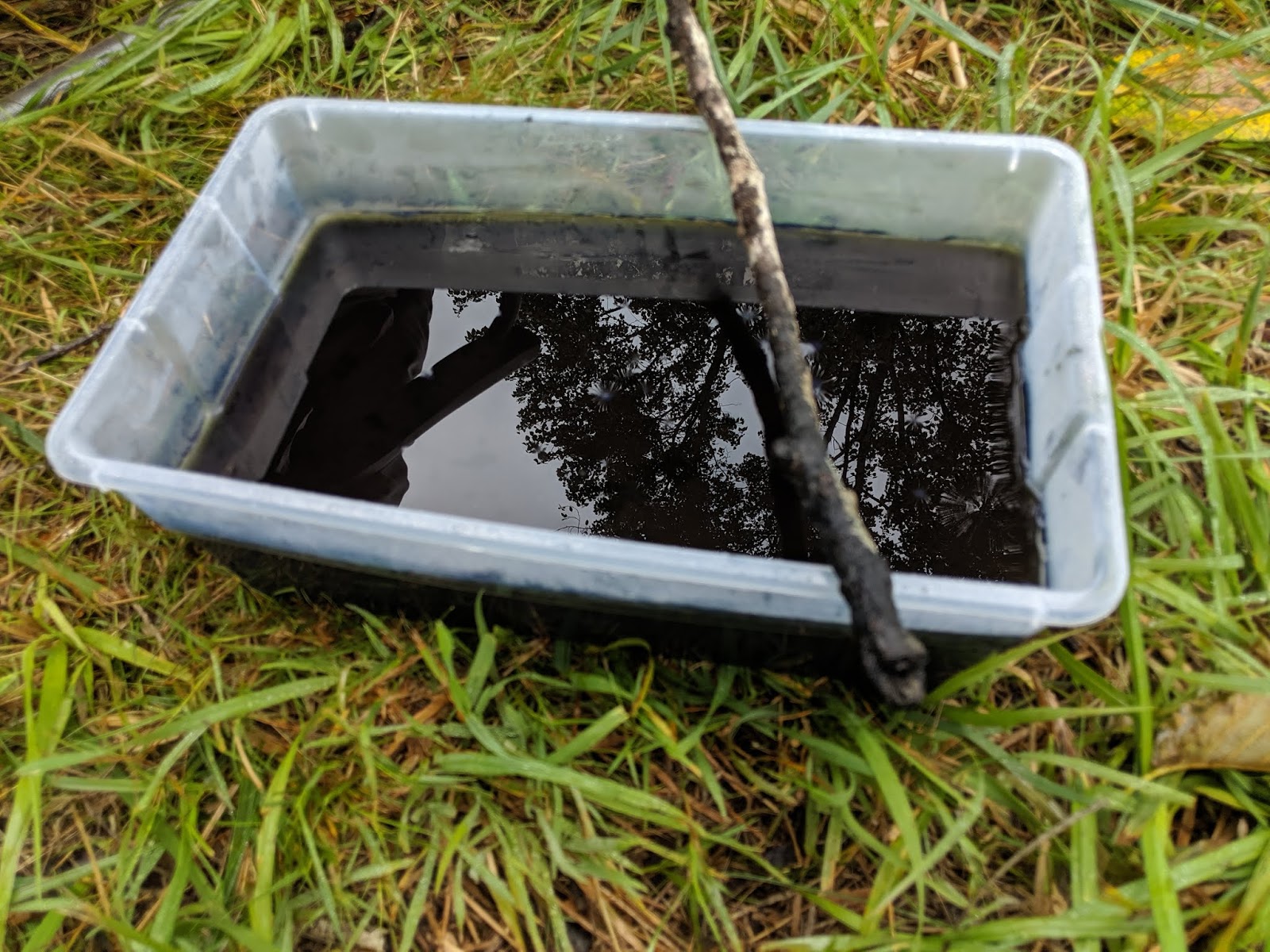
We used soda ash and a chemical called sodium dithionite to achieve our alkaline solution. I read about 10 different recipes and ended up deciding to do a test vat first to try out Claire's suggested recipe (which was, from my memory, 1:1:1, so 10 g woad, 10 g soda ash and 10 g sodium dithionite) - that may or may not have been correct, but that was what I wrote down in my notes! I had some measuring tools, but no scale, pH paper or thermometer (so I felt I was doing in fairly imprecise, but - with the exception of the scales, I think it would have been much like this anyway). I mixed the soda ash with roughly 200 ml of warm water and separately created a paste with the 10 g of woad (with 30 ml roughly of water) - we then combined them in a soda ash solution and allowed 30 minutes to pass. We then added that solution to a vat of 2.5ish liters of warm water and sprinkled 10 g of sodium dithionite onto the surface. Note: fiber was soaked overnight to remove oxygen from the fibers and we heated river water in an iron kettle, so there are a number of uncontrollable factors we were likely dealing with related to the composition of the water and adding iron into the mix. I also used plastic tubs because they were more affordable than copper cauldrons.
Materials:
Before pictures of linen and wool for dye experiments (linen is the same color as in the cap picture and the wool is a dress I cut out):
First vat attempt:
I knew something didn't look quite right because we should have seen a coppery sheen on the top of the vat and the vat itself should have appeared more yellowish green. Directions I had printed off from the site I ordered the dyeing materials from (http://www.woad.org.uk/) said to try adding more sodium dithionite. I did that, which made the color more yellow, but didn't include the coppery sheen I was looking for. I decided to go for it, since it was just a small test. Here's some video/photos from the result:
Vat after adding more sodium dithionite:
Here goes nothing:
Dyeing Video:
I decided to do a second dip (which was suggested) to see what happened:
The woad took very slowly (as you can see from the videos) - this may be because the pH wasn't quite right.
First Day Results (I did a piece of linen fabric and bleached linen thread) - both are still wet in the photos:
I was pretty thrilled to have dyed my materials a different color (even though it took more than 10 minutes) and it gave me confidence going into day two!
For my second day of dyeing, I decided to stick with the formula that worked the day before... I just made a lot more of it! I used 100 g of soda ash, 100 g of woad, and 200 g of sodium dithionite (rough numbers here, I didn't have precise measuring tools, but knew how much I started with the day before). I dissolved the soda ash in 3 liters of warm water and the woad into 300 ml of warm water to make paste. I then mixed the two together and waited for roughly 30 minutes - after that, I submerged the solution into roughly 35 liters of warm water, added the 200 g of sodium dithionite to the surface, and kept it close to the fire to stay warm (that was a lot of river water to heat!!). That solution rested for an hour.
This time, we got the coppery sheen on top of the vat, but the dye vat was much darker than the day before. I didn't have more materials to play with, so we decided to just go for it as it was! I dyed my cut out wool dress, some extra material, and redipped my dyed linen from the day before. Reginleif dyed a beautiful piece of diamond twill linen!
Woad/soda ash solution (yes, I used a stick to stir):
Dye vat with coppery sheen and warming by the fire:
Wool dye video (much faster this time around, so maybe the pH was closer to what it was supposed to be):
Dyeing results (1st dip):
Dyeing results (2nd dip):
We rinsed our work in the river - the water's current helped take the excess dye out of the fabric:
Final Result (Wool - see starting cream color at the beginning of post):
Final Result (Linen - see starting natural color at the beginning of post):
Final Result (Wool):
I'm very pleased with the results of this experiment - the blue is a lovely color and I look forward to sewing my dress and head covering!
Apprenticing and Early Summer 2019 Projects
First and foremost, I had my apprenticing ceremony in May. I've been Meistara Reginleif's student for a year and we both agreed that we wanted to move forward with an formalized apprentice/laurel relationship. I was thrilled because I have a great respect for my laurel and have had a lot of fun trying new things to help make the work I do more authentic. Here is a photo from my apprenticing ceremony (we sword oaths on an oath ring):
I also created this Snartemo II belt for my laurel as a thank you gift for taking me on as her apprentice:
I've also been busy creating tablet woven pieces for others! Mistress Drifa was put on vigil to become a laurel and had her ceremony at An Tir West War while I was in Japan. I wanted to contribute to her laureling garments because she helped me quite a bit when I first started tablet weaving - it felt appropriate to create something for her that would show her efforts were appreciated! I created this unique purple/gold pattern that was sewn onto her underdress and apron panel:
Last, but certainly not least, I created a wire brocade piece for her Majesty Shaya's step down. The piece went on her apron dress:
I'll be doing more sewing and weaving this fall as I start to plan new garments and my competition piece for Kingdom A&S! More posts to come!
Monday, July 1, 2019
Athenaeum and Tension/Weight discussion for Warp-Weighted Tablet Weaving
![]() |
| photo by Steve Somers |